From the ancient Vedas and the epic Mahabharata, India has a long and distinguished tradition of oral and literary culture that continues to flourish to this day. Now literature festivals have begun to bloom throughout the country.
Literature festivals are celebrations of words, of the written and oral word. But they are much more. They are meeting places of writers and thinkers, where ideas are exchanged, thoughts are shared, and creativity knows no bounds.
The 8th Edition Orange City Literature Festival is a vivid reminder of this great literary and cultural tradition. It is a festival of Indian minds – classical and modern, local and foreign – a celebration of our cultural traditions as well as a look at what the future holds. A festival that embraces all genres of writing, from all corners of the country.
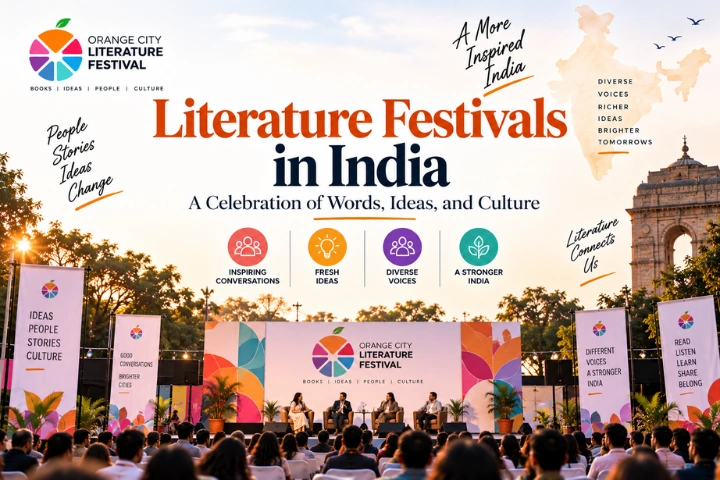
The Rise of Literature Festivals
The idea of having a literary festival started to blossom in the early 2000s. The Jaipur Literature Festival (JLF) began in 2006 and "moved from strength to strength and started taking the form of today's global giant." This relatively small beginning led to the current situation: every city wants to host such events.
Now, all Indian cities have their own literary festivals. Every year, Kolkata, Hyderabad, Kerala, Bangalore, and Nagpur's Orange City Literature Festival are famous for their events. Moreover, each city's festival is unique and has its own character. It is clear that all of these fairs' growth and development could not happen without people's interest in literature and art in general. It is also a great sign that people still gather, discuss, and share ideas about books and different kinds of writings. In addition, the book fairs' rise and popularity prove that literature can bring people together despite their conflicting beliefs or ages.
A Platform of Diverse Voices
The uniqueness of India's literature festivals lies in the fact that they embrace diversity. It is not only the famous authors and those writing in English who are given a platform to express themselves; people from all corners of the country are welcomed.
Various sessions provide a forum in which works written in Hindi, Marathi, Tamil, Bengali, Urdu, Assamese and Malayalam, as well as English, are presented. The inclusion of multiple languages gives the literature a unique flavour. It helps give exposure to regional language writing as well. A diverse group of attendees can understand the significance of such an event.
The festivals also give scope for new and marginalised writers and poets. It gives women writers and writers from tribal and rural societies an opportunity to voice their concerns and represent their works before a larger audience.
Where Ideas Unite With Culture
Every single Indian literary festival showcases an array of topics and activities apart from the main theme of reading and signing of books. Different sessions are organised to deliberate major issues relating to history, gender, ecology, philosophy, and technology, among other related topics. Thus, one can use literature as a tool to understand various aspects of life.
The festivals enable people to connect to the theme being presented. This is made possible by conducting workshops on such subjects as writings, narrating and translating. The above will enable a person to not only gain knowledge but also participate in the process of content creation. In addition, one can also learn to translate.
The above events take place together with other activities such as cultural shows and exhibitions. These are conducted simultaneously so that a person can attend to their proceedings and at the same time follow up on the sessions that are being conducted. As a result, the individual's emotions are engaged together with his or her cognitive abilities. There is no single aspect of a particular being that is left unattended. Literature is hence presented as a comprehensive issue that needs to be understood from all points of view.
Reading from books can never replace the value that comes from hearing literary works. The latter acquires more value when the content is presented alongside music. The same applies when one interacts with other people. It is in this regard that such a festival is a celebration of ideas and culture.
Connecting Readers and Writers
The literature festivals of India create a platform for both readers and writers. For the readers, it becomes a special treat as they get an opportunity to meet their beloved writer and have a clear understanding of their work. For the writers, who aspire to achieve excellence, the literature festivals help them learn and improve their skills.
These festivals give young writers exposure through open mic and poetry slams. In this festival of fairs, the writers get a chance to interact with the publishers and the editors, hand in their manuscript, and get it published with their valuable work.
The most special thing about such festivals is the interaction between the writers and the readers. They create a sense of togetherness as the readers get to listen to the writers recite their work, which gives the literature a whole new meaning that cannot be achieved at home.
Literature, once confined to readers, now takes flight as people from all walks of life interact and contribute to the development of better reading culture in society.
Showcasing India's Cultural Richness
Each of India's literary festivals is a celebration of the state it is held in. While Jaipur's festival is about Rajasthan's royal past, Kolkata's is about Bengal's intellectual tradition, and Kerala's is about coastal colourfulness, the Orange City Literature Festival in Nagpur is about Central India's hospitality and youth.
The festivals are not only about the literature and languages but also about showcasing the cultural heritage and keeping it relevant in the present.
The Features of the Literature Festivals
Literature festivals create an environment which is completely focused on social issues. This provides a unique opportunity for constructive conversations with the possibility of forming alliances and engaging in dialogues aimed at resolving pressing matters of society, including digital privacy issues. The literature festivals help attendees, especially students, to see the importance of a literary work for society and its power to change the world, starting with the reader themselves.
Boosting Local Economies and Communities
Hosting literary festivals has a significant effect on the host community by creating demand in the local hotel market, spurring activity in local coffee shops, and helping local shops that sell books. In addition, the number of book sales increases due to the popularity of local independent bookshops, and various outreach activities promote literacy and encourage school participation. Thus, it can be concluded that such events have a profound impact on communities by stimulating local economies and promoting communities through investment.
The Future of Lit Fests in India
Literature festivals in India are taking off from their physical sites by combining the event with online streaming, allowing people from smaller towns to interact with the authors. The events will continue to embrace technology while balancing it with tradition to keep the storytelling at the core of the event.
Conclusion
Literature festivals in India are events of great imagination, intellect, and identity. The events connect readers and writers, as well as keep the discourse between art and society vibrant.
Both big and small fairs have one thing in common: they add a stone to the literary history of our country. Overall, the festivals are a great way to promote literature because they introduce the public to the power of words and the diversity of expression.
Indeed, in a culturally and socially diverse country like India, such events as literature festivals are an exercise in identity. They are a way to both understand and be understood, as well as transform society for the better, as shown every year at the Orange City Literature Festival.