Walk through the Orange City Literature Festival in Nagpur and you'll notice it almost immediately. Authors going back and forth on panels. Poets reading their own lines out loud. People wandering between stalls, hunting for whatever book they didn't know they needed. It's a festival that runs entirely on words. But step away from the main stages, into the smaller rooms tucked off to the side, and something quieter is happening. Arguably more important, too. Students are learning to actually speak in front of people and mean it.
Here's the thing, though. For most young people, coming up with a good idea was never really the problem. Ask any student, and they'll have an opinion on something, sometimes several. What trips them up is saying that idea out loud, clearly, in front of a room full of people watching. That's exactly the gap this public speaking workshop for students is built to close.
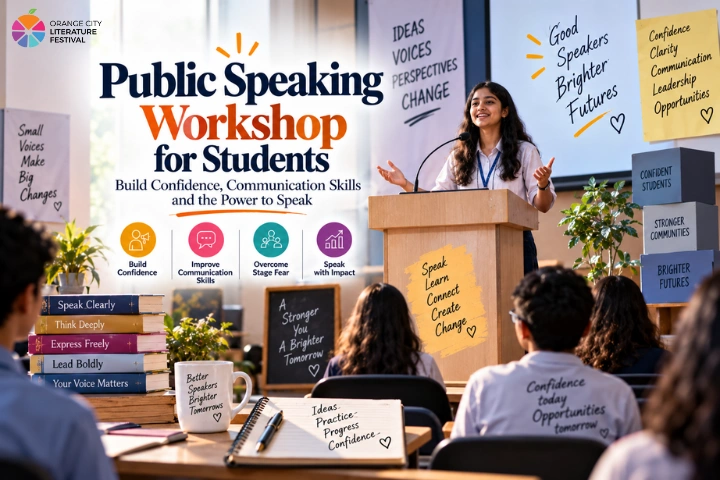
A Fear Most People Share
Ask a group of students what scares them most, and public speaking usually wins, and not by a little. The racing heart, the dry mouth, that horrible blank second where the next word just refuses to show up. None of that means anything's wrong with these students. It's just the body doing what bodies do under pressure.
Part of the issue is how public speaking gets introduced in the first place. In school, it's tied to a grade. A rubric. Sometimes a debate format where one shaky sentence can cost you the whole round. High stakes, not much room to actually learn. OCLF flips that entirely. Nobody's grading anyone here. There's no academic weight sitting on a student's shoulders while they talk. They get to try a speech, mess it up a little, adjust, and go again without any of it counting against them later. And once that pressure disappears, something shifts. Stage fright stops looking like some permanent flaw and starts looking like what it actually is: a skill. One that gets easier the more you practise it.
So What's Actually Going On in the Room?
Nothing like the generic advice you've probably heard before – no "just imagine the audience isn't there." This public speaking workshop for students is built around doing, not sitting and listening to someone talk at you.
Body language comes first, and for good reason. Before a student even opens their mouth, their posture and eye contact have already said something to the room. So there's real time spent on standing like you mean it, using gestures that feel natural instead of rehearsed.
Then there's the voice itself. A brilliant point delivered in a flat monotone still falls flat. Students spend time playing with pace, adjusting tone, and getting comfortable with pauses instead of rushing straight through them.
There's also a piece on organising thoughts on the fly, probably the trickiest part of speaking without notes. A basic structure helps: make your point, back it up with a reason, give an example, and circle back. It gives students something to hold onto when their brain starts racing ahead of their mouth.
And then, somewhat unexpectedly, there's listening. Reading a room. Noticing when people lean in or check out. Turns out that's half of what makes someone actually good at this.
Why Doing This at a Festival Changes Things
Running a public speaking workshop for students inside OCLF, instead of a classroom, does something a school setting just can't replicate. Step outside for five minutes, and students are surrounded by people who do this professionally: journalists, authors, and performers who can hold three hundred people in total silence with nothing but a well-placed pause.
That proximity matters more than it sounds like it would. A student rehearses their two-minute speech, walks outside, and catches an author holding an entire crowd's attention without seeming to try. The lesson lands on its own, without anyone needing to spell it out. Good public speaking was never about sounding polished or putting on some performance voice. It's just someone being honest, out loud, in front of people who are actually listening.
It's Rarely Just About the Speech
Sure, the short-term goal is getting through a few minutes without freezing up completely. But that's really just the surface of it. Students who get more comfortable speaking tend to carry that confidence with them everywhere. Group discussions feel less intimidating. Interviews feel survivable instead of terrifying. Even ordinary conversations start to feel a little easier.
And underneath all of it, something bigger tends to happen. Once a student realises people actually listen when they talk, they start talking more. Speaking up in class. Pushing back when something feels off. Stepping forward to lead something instead of hanging back, waiting for someone else to go first.
Stepping Up to the Mic
By the last session, the whole room feels different. The nervous mumbling from earlier that day has turned into something steadier, voices that actually carry. Hands might still be a little sweaty, sure, but the posture's straighter, the eye contact holds, and there's a confidence in the room that simply wasn't there that morning.
OCLF always been about stories, the written kind and the spoken kind. This public speaking workshop for students just makes sure the youngest people in the building don't only get to hear great ones; they get to stand up, take a breath, and tell one of their own at the Orange City Literature Festival.