What if you could explore a literature festival instead of just attending it?
With author conversations and book launches, many festivals today create spaces where attendees can find handmade crafts, discover local artists, and support local culture in more tangible ways. A flea market at a literary festival fits right in with this setting. After all, stories can be found beyond books too.
They also live in paintings, fabrics, pottery, handmade objects and the traditions behind them.
A well-designed flea market brings these different art forms together and gives local artists the opportunity to reach a wider audience. But the connection is much deeper than just a transaction. It shows how literature festivals are becoming a melting pot of culture where reading, creativity, community and local identity can share the same space.
Why Are Literature Festivals Becoming More Than Book Events?
A literature festival may focus on books, but the experience is much broader. In recent years, Indian literary events have increasingly brought music, art, food, performances, crafts and community activities into the same space. This shift is visible in the programming itself. At the Jaipur Literature Festival 2026, for example, the festival has a bazaar and art exhibits set alongside literary discussions and musical performances.
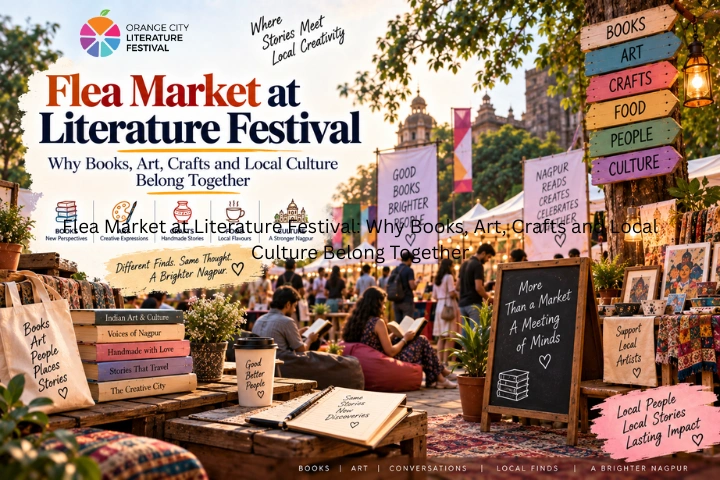
The same broader approach can be observed everywhere else. The Orange City Literature Festival is a good example of this. Its recent editions have combined literature sessions and book launches with workshops, art exhibitions, live art, cultural performances and a marketplace featuring local artists and businesses. In the 2025 edition, the festival's flea market was a big attention grabber with handmade products and local creative talent.
This broader approach makes sense as literature is closely tied to the culture around it. A conversation about the city, community or tradition can naturally lead to its arts, crafts, music and people. Having a flea market at the festival adds another layer to that experience, allowing visitors to experience stories and discover the creative and cultural world around them.
7 Reasons Why Flea Markets & Literature Festivals Belong Together
Literature festivals are a celebration of the written word, and flea markets are a celebration of local art and culture. Combining the two enhances both their relevance.
1. Both are built around discovery
Literature festivals encourage readers to discover new authors, ideas and perspectives. Flea markets function the same way, inviting visitors to browse, explore and stumble upon things they did not expect. Together, they create a surrounding where curiosity drives the experience.
2. Crafts Tell Stories too
While books communicate with words, crafts communicate through patterns, materials, techniques and traditions. Handicrafts reveal something about a particular community's history, their identity and the artist's inspiration to make them a carrier of stories that can be explored at the literature festival.
3. They Give Local Creators a Platform
A literature festival can bring together a large, culturally engaged audience. A flea market gives local artists, artisans, designers and small businesses an opportunity to reach people directly, giving them visibility and adding local flavour to the festival.
4. The Experience Becomes More Interactive
Author sessions are largely listening experiences, while marketplaces encourage people to browse, ask questions, handle products and speak with creators. Adding a flea market makes the festival more interactive and gives visitors the opportunity to interact between sessions.
5. They Strengthen the Festival's Local Identity
A literature festival can become closely associated with the city or region where it is conducted. It usually features local crafts, artists, food products and independent creators, allowing visitors to experience that place through more than literature, giving the festival a strong cultural identity.
6. They Bring Different Audiences Together
People attend literature festivals for different reasons apart from books. Having a flea market makes a festival more inviting for families, students, art enthusiasts, casual visitors and local shoppers. This appeal can make it feel more open, accessible and representative of the wider community.
7. They Turn the Festival Into a Community Space
Combining a flea market with a literature festival gives people more reasons to stay, explore and interact beyond the scheduled sessions. When different people share the same space, the festival becomes a lively gathering rather than a simple series of talks and literature events.
What to Expect From a Literature Festival Flea Market?
The flea market at a literature festival is usually much more than a row of shopping stalls. Depending on the festival, visitors can expect a mix of books, artwork, handmade crafts, lifestyle products, literary merchandise and locally made goods often presented with the main programme. Many festivals display these artisan products, handmade creations, creative merchandise and local handicrafts.
The experience is also shaped by the place where the festival is held. OCLF is held at the Chitnavis Center in Nagpur. It is a space for cultural events that brings together independent artists and writers with the local cuisine, creating a space that represents the region.
For visitors this means they offer space to browse books, meet creators and discover handmade products and pick up something with a story behind it. The best part of a flea market like this is the unexpected find. It could be a new artist, handicraft or a literary session that can make a difference for the attendees.
Conclusion
From this whole article, one may conclude that a literary event might provide much more than just book-related discussions. Its well-curated flea market enhances the experience by combining local designers, independent booksellers, artists, artisans, and handmade goods. It allows visitors room to browse at their own speed, find surprising connections, and meet the artists behind the piece. Concurrently, it can enable little creators to reach a culturally involved audience and help the festival to more closely relate to its host city and creative legacy.
Therefore, a flea market at a literary event seems less like an additional feature and more like a logical offshoot of the festival itself. This approach is shown by the Orange City Literature Festival (OCLF)'s mix of literary sessions, workshops, art shows, contests, and curated booths boosting regional artists and business owners. The 2025 version also attracted notice for its active flea market showcasing regional creative talent and handcrafted goods.