
Turning the pages…
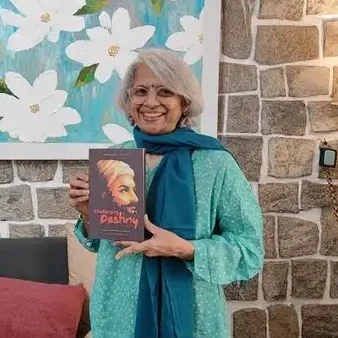
Medha Deshmukh Bhaskaran is the author of Chhatrapati Shivaji's bestselling biography, Challenging Destiny (2016, published by Crossword Bookstores). It was nominated in two categories at the Raymond Crossword Book Awards in 2017 and has been translated into Marathi Zunz Niyatishi and Hindi Niyati ko Chunauti by Manjul Publishers. Its Kannada edition is out, and is published by Prism Publishers. Challenging Destiny now proudly carries the designation of ‘National Bestseller’. Her book on the captivating realm of pharmaceuticals and medicines, drawn from her personal experiences, Prescription of Life (Crossword Bookstores), was launched in 2018.
Penguin Random House published her two works of historical fiction: ‘Frontiers – A Relentless Battle between Aurangzeb and Shivaji’ in 2018, and ‘Life and Death of Sambhaji’ in 2021, this book has been tagged as a bestseller on Amazon for a few months. ‘Frontiers’ has been translated into Marathi as Ranasangram by Majestic Publishers. ‘Life and Death of Sambhaji’ has been translated into Hindi as Shivaji Maharaj Ke Suputra ki Shouryagatha by Prabhat Publishers and into Marathi as Chhatrapati Sambhaji – Jeevan and Balidaan by Sakal Media Group. Both Challenging Destiny and Life and Death of Sambhaji are available as audiobooks.
Challenging Destiny for Young Readers was launched in February 2025 by Crossword Bookstores. The Kannada version of Challenging Destiny will be released later in 2025 by Prism Publishers. Sakal Media Group recently published her latest book on social issues, Up Against Darkness, along with a research-based book, ‘The Story of Immunity’, for medical and non-medical audiences. Up Against Darkness won the FICCI Special Jury Award for Publishing in 2024 and has been translated into Marathi.
Medha is a microbiologist who has worked in marketing and business development for food and pharmaceutical companies in countries like Germany, India, and the United Arab Emirates. From a young age, she has dabbled in poetry in Marathi and English. Medha has written articles on various subjects for leading newspapers in India (Indian Express) and in the Gulf (Khaleej Times and Gulf News).
Topic
Legacy of Lions | Medha Bhaskaran on Shivaji and Sambhaji’s Courage That Challenged Empires | OCLF
On 22nd Nov 2025 01.00 PM TO 01:40 PM
The session "Legacy of Lions: Shivaji and Sambhaji — Courage That Challenged Empires" featured author Medha Bhaskaran in conversation with Dr Sharad Bhave. The discussion highlighted the extraordinary lives of Chhatrapati Shivaji Maharaj and Chhatrapati Sambhaji Maharaj, the deep research behind Medha’s work and the personal journey that shaped her writing.
Medha Bhaskaran shared how her commitment to honest historical writing led her to spend a decade studying Mughal history before beginning her books on the Marathas. After the loss of her husband, she turned grief into purpose and chose writing as her path forward. She spoke about her affectionate use of “Shivae” for Shivaji Maharaj, noting that readers have always recognised the sincerity behind it.
The session explored how Shivaji and Sambhaji were shaped by their times, responsibilities and distinct leadership styles, yet were equally essential to the rise of Maratha power. Audience questions added depth to the discussion, covering military strategy, Mughal–Maratha interactions, economic centres like Surat and how warfare evolved across both reigns.
The session concluded with an appreciation of the enduring courage, legacy and vision of the two great leaders, as well as the author’s devotion to presenting their histories with authenticity and rigour.
Topic
Fact, Faith and Footprints | When History Breathes with Medha Bhaskaran, Aabhas Maldahiyar, Anuja Chandramouli and Chandrachur Ghose | OCLF
On 22nd Nov 2025 03.00 PM To 03:40 PM
The session "Fact, Faith and Footprints: When History Breathes, a Nation Remembers" brought together authors and researchers Medha Bhaskaran, Aabhas Maldahiyar, Anuja Chandramouli and Chandrachur Ghose in conversation with Dr Sanjiv Chugh. The panel explored how India’s past continues to shape our identity through evidence, memory and storytelling.
Medha Bhaskaran spoke about her research on Chhatrapati Shivaji Maharaj and the responsibility of reclaiming historical narratives with balance and depth. Aabhas Maldahiyar discussed his shift from Marxist interpretations to evidence-based scholarship influenced by the Ajanta caves, and his commitment to presenting history with honesty. Anuja Chandramouli reflected on the thin line between myth and history, emphasising the human stories at the heart of ancient texts. Chandrachur Ghose shared insights from his research on political history, describing himself as a seeker who invites readers into the discovery process.
The discussion highlighted how history is not static but a living dialogue between fact and faith, reminding the audience to question, explore and rediscover voices that shaped the nation.