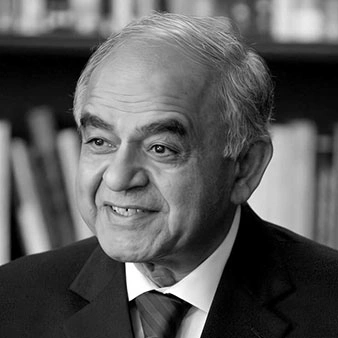
Gurcharan Das is one of India's most celebrated authors and thinkers. He is best known for two iconic, best-selling books: India Unbound offers a personal account of India’s economic rise and is available in numerous languages and filmed by the BBC. The Guardian called it 'a quiet earthquake!' The second,The Difficulty of Being Good, illuminates our day to day moral dilemmas, and ‘one of the best things I’ve read about contribution of great literature to ethical thought,’ according to the philosopher, Martha Nussbaum. The New York Times says, 'Something tremendous is happening in India, and Das, with his keen eye and often elegant prose, has his finger firmly on the pulse of the transformation.'
Gurcharan Das graduated in philosophy with honors from Harvard University, where he was inducted in 2013 into Phi Beta Kappa for ‘high attainments in liberal scholarship.’ He also attended Harvard Business School (AMP) where he is featured in four case studies. He was CEO of Procter & Gamble India and Managing Director, Procter & Gamble Worldwide (Strategic Planning) before he retired early to become a full-time writer. His newspaper columns on current issues and philosophy are among the most widely read in the country.
His other books include India Grows at Night: A liberal case for a strong state, which was on the FT’s best books for 2013. Another major work, Kama: The Riddle of Desire, teaches how to cherish desire in order to live a rich, flourishing life. He has also written a novel, A Fine Family; a book of essays, The Elephant Paradigm, and an anthology, Three Plays. His most recent titles are a memoir, Another Sort of Freedom, which describes his lifelong struggle to give meaning and purpose in life, and a longish essay, and The Dilemma of the Indian Liberal. He has edited for Penguin a 15-volume economic and business history of India, and he lives in Delhi with his wife.
Topic
Making a Life | Gurcharan Das on Purpose, Values and Personal Meaning | OCLF
On 22nd Nov 2025 04.00 PM To 04:40 PM
"The session ""Making a Life"" featured author and public intellectual Gurcharan Das in conversation with Dr Mrunal Naik. The discussion invited the audience to look beyond careers and consider what it truly means to build a meaningful and purpose-driven life.
Gurcharan Das reflected on his own journey, from his childhood memories during the partition to the influence of his parents and the experiences that shaped his identity. He explained how writing a memoir encourages honest self-reflection and how it differs from an autobiography by focusing on themes, meaning and inner clarity. He urged the audience to keep asking what life means to them at every stage and to recognise which memories matter enough to carry forward.
The conversation highlighted the importance of choosing values over routine, purpose over pressure and meaning over mere achievement. Audience interactions centred on how personal narratives can guide life choices and bring deeper understanding.
Topic
What Can We Learn from the Past | Gurcharan Das in Conversation with Akshay Chopra | OCLF
On 22nd Nov 2025 02.00 PM TO 02:40 PM
The session "What Can We Learn from the Past" featured renowned author and public intellectual Gurcharan Das in conversation with author and innovation strategist Akshay Chopra. The discussion explored how historical choices, economic patterns and civilisational strengths can guide decisions in the present.
Gurcharan Das reflected on India’s ancient economic power, noting how Romans imported Indian goods while India had little need for their products. He spoke about India’s structured systems, wealth legacy and the misinterpretations that often cloud historical understanding. The conversation also touched on post-independence economic policy, resistance to capitalism and the impact of high taxation that pushed many to sell assets to comply with regulations.
Drawing from the Arthashastra and ideas of Rajdharma, he emphasised the need for rulers and citizens alike to focus on welfare, clarity and responsibility. Audience questions explored how ancient economic principles could shape modern policy and personal financial decisions.
The session concluded with a reminder that the past is meaningful only when interpreted carefully. Revisiting history with curiosity and clarity can help individuals and societies make better choices for the future.