
Turning the pages…
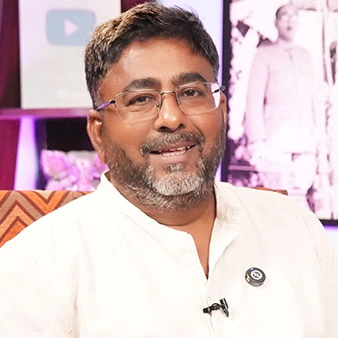
Chandrachur Ghose is an author, columnist and public speaker on history, politics, economics, and environment. He graduated from Visva Bharati (Santiniketan) and the University of Sussex. He was a Fellow at the Foundation for Indian Historical and Cultural Research (FIHCR) during 2024-25.
Ghose left his two decades’ career as an environmentalist and a business strategy consultant in 2018 to become a full-time author. His books, all of which have been national bestsellers, include Conundrum: Subhas Bose’s Life After Death (2019, Vitasta Publishing, co-authored), the definitive biography of Netaji Subhas Chandra Bose, Bose: The Untold Story of an Inconvenient Nationalist (2022, Penguin Random House), 1947-57, India: The Birth of a Republic (2023, Penguin Random House) and The Bose Deception (Penguin Random House, co-authored with Anuj Dhar).
His latest book Many Shades of Saffron: Decoding 100 Years of RSS (Rupa Publications) is now available across bookstores.
Topic
Fact, Faith and Footprints | When History Breathes with Medha Bhaskaran, Aabhas Maldahiyar, Anuja Chandramouli and Chandrachur Ghose | OCLF
On 22nd Nov 2025 03.00 PM To 03:40 PM
The session "Fact, Faith and Footprints: When History Breathes, a Nation Remembers" brought together authors and researchers Medha Bhaskaran, Aabhas Maldahiyar, Anuja Chandramouli and Chandrachur Ghose in conversation with Dr Sanjiv Chugh. The panel explored how India’s past continues to shape our identity through evidence, memory and storytelling.
Medha Bhaskaran spoke about her research on Chhatrapati Shivaji Maharaj and the responsibility of reclaiming historical narratives with balance and depth. Aabhas Maldahiyar discussed his shift from Marxist interpretations to evidence-based scholarship influenced by the Ajanta caves, and his commitment to presenting history with honesty. Anuja Chandramouli reflected on the thin line between myth and history, emphasising the human stories at the heart of ancient texts. Chandrachur Ghose shared insights from his research on political history, describing himself as a seeker who invites readers into the discovery process.
The discussion highlighted how history is not static but a living dialogue between fact and faith, reminding the audience to question, explore and rediscover voices that shaped the nation.
Topic
Many Shades of Saffron | Chandrachur Ghose on a Century of Ideas, Identity and Institutions | OCLF
On 22nd Nov 2025 12.00 PM To 12:40 PM
The session "Many Shades of Saffron: A Century of Ideas, Identity and Institution" featured author and researcher Chandrachur Ghose in conversation with Dr Supantha Bhattacharya. The discussion explored how ideas evolve over time and how they shape institutions, narratives and public discourse across generations.
Drawing from archival sources, parliamentary records and historical documentation, Chandrachur Ghose examined the evolution of the RSS and clarified long-standing perceptions about its role in India’s political history. He explained the distinction between organisational participation and individual involvement in the freedom struggle and highlighted how major events such as World War II, the Quit India Movement, Partition and the debates of the early 1950s influenced public perception.
The conversation reflected on how ideological labels and critiques have been repeated for decades, often without re-examining primary evidence. With thoughtful guidance from Dr Supantha Bhattacharya, the session presented a chronological and evidence-backed view of a century of evolving thought, identity formation and institutional growth.
Audience engagement brought forward questions on political rhetoric, narratives and the shaping of historical memory. The session closed with the reminder that understanding institutions requires contextual study, critical inquiry and reliance on documented history.